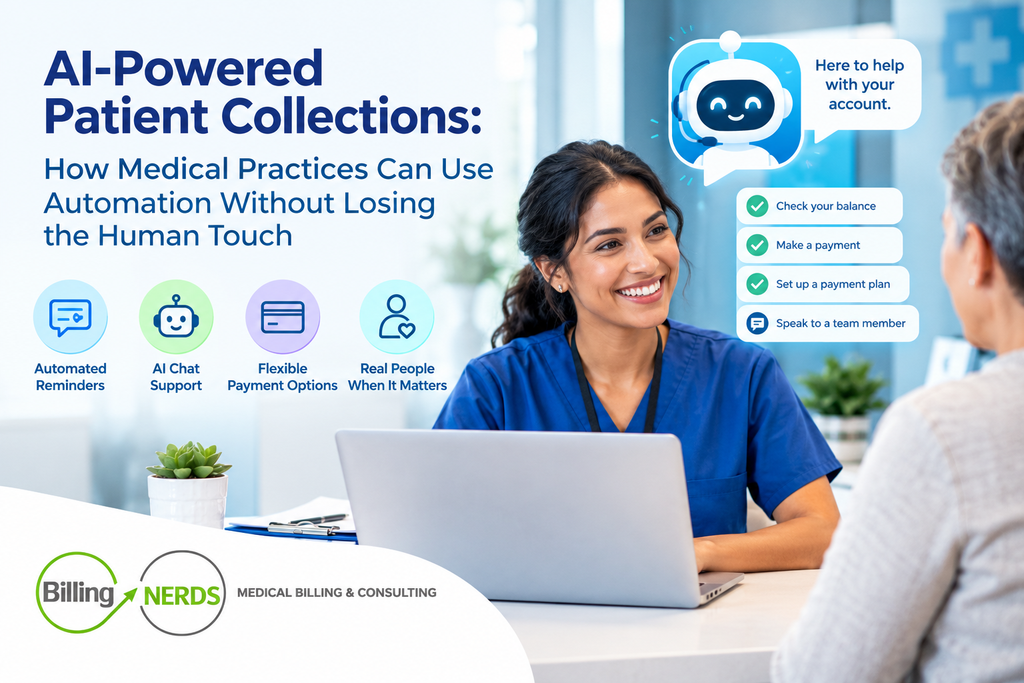
Medical billing technology is evolving beyond claims processing.
Artificial intelligence is increasingly being used to support the way healthcare organizations communicate with patients about outstanding balances, payment options, and account questions.
On October 12, 2026, The Guardian reported on the growing use of AI across the medical debt and billing process, including automated billing messages, patient-facing chatbots, and tools designed to help organizations manage collections. The reporting also highlighted concerns about fairness, medical debt, and the risks associated with using automated systems to make financial decisions about patients.
Automation may help staff handle routine account inquiries and send timely payment reminders. It may also introduce problems if patients receive inaccurate information, cannot reach a person when they need help, or are offered payment options that do not reflect their actual circumstances.
The goal should not be to automate every conversation. It should be to use technology to make patient billing more organized, understandable, and responsive.
What Is AI-Powered Patient Collections?
AI-powered patient collections refers to the use of artificial intelligence to support activities related to collecting patient balances.
Depending on the platform, these activities may include:
- Answering routine billing questions
- Sending payment reminders
- Directing patients to payment portals
- Identifying accounts that need staff attention
- Organizing incoming patient inquiries
- Supporting payment-plan administration
- Identifying common reasons patients do not pay
- Helping staff prioritize follow-up
Not every platform offers all these functions, and not every automated tool uses AI. Some systems rely on simpler rules-based automation. Practices should understand the difference before choosing a vendor.
Why Patient Collections Are Becoming More Challenging
Patient collections can be difficult because patients may face deductibles, copayments, coinsurance, and balances that remain after insurance processing.
A patient may also have questions about whether insurance has paid, whether a service was covered, or why the final balance differs from an earlier estimate.
If the billing office is difficult to reach, these questions may remain unresolved.
Automation can help handle straightforward inquiries, but it cannot make an incorrect bill accurate or resolve every insurance dispute.
The first step toward better collections is ensuring that the underlying account information is correct.
Four Ways AI Can Support Patient Collections
1. Timely Payment Reminders
Automated systems can send reminders through approved communication channels.
A reminder may direct a patient to a secure portal where the patient can review an account and make a payment.
Practices should ensure that messages are accurate, appropriately timed, and designed to protect patient privacy.
2. Answers to Routine Billing Questions
A patient may want to know how to make a payment, where to find a statement, or whom to contact about an account.
An automated assistant can potentially answer basic questions using approved information.
However, questions about disputed charges, insurance decisions, financial hardship, or sensitive circumstances should be routed to a qualified staff member.
3. Identifying Accounts That Need Human Attention
AI tools may help categorize incoming messages and identify accounts that require additional review.
For example, a message indicating that a patient disputes a charge should not be treated the same way as a routine request for a payment link.
A well-designed workflow can direct different inquiries to the appropriate team.
4. Making Payment Options Easier to Navigate
Some systems can help patients understand available payment methods or navigate established payment-plan procedures.
The practice must define the options and eligibility rules. AI should not invent discounts, promise arrangements that have not been approved, or make unsupported claims about a patient’s financial responsibility.
Why Automation Must Start With Accurate Billing
AI cannot fix an incorrect account simply by communicating about it more efficiently.
Before deploying automated collection tools, practices should confirm that balances are calculated correctly, insurance payments have been posted appropriately, and adjustments have been applied.
They should also establish a process for correcting errors and handling disputed accounts.
Otherwise, automation may accelerate the delivery of inaccurate bills and increase patient frustration.
A useful rule is to verify the account before escalating collection activity.
Protecting Patient Privacy
Patient billing communications can reveal sensitive information.
Practices should understand how an AI vendor handles patient data, what information is stored, who can access it, and whether the vendor’s practices align with applicable privacy and security requirements.
Where HIPAA applies, practices should evaluate the relevant obligations and vendor arrangements before using a tool with protected health information.
Additional safeguards should include appropriate access controls, secure communication methods, documented vendor responsibilities, and a process for responding to privacy incidents.
Patients should not have to sacrifice privacy to receive a convenient billing experience.
Fairness and Patient Financial Hardship
An important concern in AI-powered collections is whether automated systems treat patients fairly.
An algorithm might prioritize accounts based on predicted payment behavior or recommend different collection approaches for different groups of patients.
Such approaches deserve careful scrutiny.
A practice should understand the factors that influence automated decisions and determine whether they are appropriate, explainable, and consistent with applicable laws and policies.
Practices should be especially cautious about allowing AI to make consequential decisions about payment flexibility, financial hardship, or collection escalation without meaningful human oversight.
The objective should be to help patients resolve their accounts, not to make it more difficult for people facing financial challenges to obtain assistance.
Keep Human Support Available
Patients do not always fit neatly into an automated workflow.
Someone may have lost insurance coverage, experienced a billing error, received an unexpected balance, or need clarification about a payment already made.
An automated assistant may not have enough context to resolve the issue.
Practices should provide a clear way to reach a person, especially when the patient disputes the amount owed or requests additional assistance.
Human staff should also be able to review the conversation and understand what the automated system has already communicated.
How to Evaluate an AI Collections Vendor
Before purchasing an AI-enabled collections platform, practices should ask:
- What tasks does the system automate?
- Does it use AI or rules-based automation?
- How does it obtain current account balances?
- Can it distinguish routine questions from disputes?
- How are sensitive inquiries escalated?
- What patient information does it collect?
- How does the vendor protect that information?
- Can staff audit automated communications?
- How are inaccurate responses corrected?
- What performance measures are available?
- How are accessibility and language needs addressed?
Request demonstrations using realistic scenarios from the practice’s workflow.
A vendor should be able to explain not only what the system can do, but also what it cannot do reliably.
Measure the Patient Experience, Not Just Collections
A collections platform should not be evaluated solely on how much money it collects.
Practices should also monitor whether the technology improves the patient experience.
Useful measures may include:
- Payment completion rates
- Time required to resolve billing inquiries
- Number of disputed accounts
- Frequency of incorrect automated responses
- Patient complaints
- Successful escalation to staff
- Privacy or security incidents
- Staff time spent correcting automated errors
A tool that increases collections while generating more disputes and complaints may not be producing a sustainable improvement.
A Practical Way to Introduce AI Collections
Practices do not need to automate every patient interaction at once.
A sensible starting point is a low-risk task, such as sending approved payment reminders or helping patients navigate a secure payment portal.
Before launch, define the system’s scope, test its responses, train staff, and establish clear escalation procedures.
After launch, review the results regularly and adjust the workflow when problems arise.
Keep complex billing disputes, sensitive financial conversations, and exceptions within a process that provides appropriate human review.
How Billing Nerds Can Help
Billing Nerds provides Medical Billing, Documentation Review, Insurance Credentialing, Patient Statements, Business Consulting, and Strategy & Marketing.
For practices considering automated patient collections, the first step is understanding the existing billing process and identifying where patients and staff experience unnecessary friction.
A review of patient statements, account workflows, payment communication, and follow-up procedures can help practices determine where automation may be useful and where human support remains essential.
Technology should support an accurate and organized billing process, not replace the judgment needed to resolve complicated accounts.
In Conclusion
AI is creating new possibilities for patient billing and collections, but convenience should never come at the expense of accuracy, privacy, or fairness.
Medical practices can benefit from automating repetitive tasks and helping patients navigate routine account questions. The technology must still operate within clearly defined rules, use reliable account information, and provide access to human support when needed.
The best approach is not to remove people from patient collections. It is to give staff better tools while making the billing process clearer and more manageable for patients.
Author: Rhonda Scantlebury